

Spring 2021
Nicholson Construction News
Pittsburgh-based, geotechnical specialty contractor, Nicholson Construction, returns to Ohio’s Portage Lakes for the Ohio Department of Natural Resources North Reservoir Dam Project.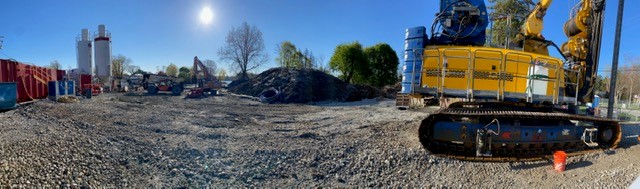
The 100-year-old North Reservoir dam will undergo a $22.9M repair project to bring it into compliance with Ohio Dam Safety’s standards. The last remediation project on North Reservoir Dam was performed in 1982. The current remediation project includes seepage cutoff, overtopping protection and replacement of the existing spillway and lake drain.
Nicholson was contracted by Beaver Excavating Company to construct a soil-mix gravity section and cutoff wall for the new dam in order to mitigate excessive seepage and to increase its factor of safety.
This is the second Portage Lakes project for Nicholson. In 2017, the company was contracted to construct a soil mix gravity section and cutoff wall for the new East Reservoir Dam.
“It’s a high compliment to be brought back on-site to build subsequent work,” said Ryan Streets, vice president, major projects. “Several core members of the East Reservoir team are back for this project, which is a huge advantage in terms of lessons learned and efficiencies we can gain.”
Nicholson’s work on the North Reservoir Dam will start in the late Spring 2021 and continue into next year. “Earning our clients’ trust and returning to their jobsites to do additional work is truly a testament to our crew’s ability to safely construct a high-quality product,” said Dario Gnoato, senior vice president, major projects, Nicholson Construction. “We’re looking forward to another great project in Portage Lakes.”
About Nicholson Construction Company:
Nicholson is a versatile geotechnical contractor specializing in deep foundations, earth retention and ground treatment. As the North American subsidiary of Soletanche Bachy, one of the world’s leading geotechnical contractors, we are part of a global network of geotechnical resources and expertise. We work in a wide range of industries and environments, from power plants and dams, to bridges and skyscrapers. Headquartered in Pittsburgh, Nicholson has offices around the country to address each region’s unique geotechnical construction needs.
ASCE Pittsburgh’s Utility Engineering & Surveying Institute Chapter has Launched!

APRIL 2021
“Coming together is a beginning; Keeping together is progress; Working together is success.” – Henry Ford
Hello UESI Members and Friends,
I am happy to announce that the Pittsburgh Utility Engineering & Surveying Institute (UESI) Chapter has officially launched! And what a time to start this endeavor! I am Alma Rettinger and I will be serving as the UESI Pittsburgh Chair in the upcoming year.
We are starting our Chapter at a time when infrastructure initiatives are in the spotlight with last week’s release of President Biden’s proposed national infrastructure spending bill. ASCE Pennsylvania is also gearing up to grade the condition and performance of the Commonwealth’s infrastructure this year, which received a C- grade in 2018 due to the poor conditions of aging drinking water mainlines, deteriorating bridges and roadways, and the severe conditions of the sewer and wastewater systems. The discussion of how to improve our infrastructure remains not just relevant but important. So this is an opportune time for our Chapter to focus not only on the current condition of our infrastructure, but also to highlight the transformation in the way our industry has been addressing infrastructure projects with innovation, and with improved risk and asset management tools.
Members across different organizations and professions have been adapting over the years to deal with the urgency of replacing aging infrastructure, responding to damages from natural disasters, and doing so with limited funding. As a whole, we are working towards improving the way we deliver projects, building towards resilience, and ultimately putting funding to better use.
ASCE’s Civil Engineering magazine Editor in Chief Laurie Shuster said last year that “the future is going to be increasingly integrated, with one field informing and influencing another.” And I believe that these coordinated efforts among multiple disciplines will continue to be a critical aspect of UESI and for the successful planning, positioning, design, construction, operation, maintenance, and management of utility infrastructure. With the goal of working together with the diverse group UESI represents and with our founding officers, Vice Chair Kate McKinley, PLS, and Secretary-Treasurer Ashwin Ranna, EIT, I am thrilled to be bringing UESI’s mission to our region!
In the short-term, we have already gained positive momentum. During the recent months, we have been planning our upcoming kick-off event scheduled for May 13, 2021. We are partnering with NUCA-PA and several co-sponsoring organizations to deliver a virtual symposium on “Leading the Way to Smarter Utility Engineering Design & Construction Damage Prevention”. This event will bring together stakeholders to discuss Utility Conflict Management, subsurface utility engineering in accordance with ASCE 38, and the future and direction of the industry. We invite you to Join Us at our upcoming event and be part of the discussion.
We hope to continue the momentum throughout our future Chapter activities! I encourage you to join the Pittsburgh Section (if you are not a current member), follow us on LinkedIn, and check for updates on our website. We will use these platforms to inform our members of upcoming events, activities, and relevant news. I also invite you to share your unique perspective on the industry as we plan for the future of our Chapter.
Whether virtual or in-person, I look forward to seeing you soon! And when we can gather again, we hope we get a chance to meet you all and say hello.
Happy spring and let’s enjoy this fresh outlook!

IWC News
ESWP sends out congratulations to the award-winning presenters from the 2020 International Water Conference!
For Best First Time Presenter Award, we congratulate Adam Sutherland, P.E., Stantec for his paper IWC 20-66, Controlling Oxidation Air in an FGD Absorber as a Means to Simplify Wastewater Treatment.
For the Best Overall Paper, congratulations to Colleen M. Scholl, P.E., HDR, Inc. for her paper IWC 20-58 , The Value (and the Challenges) of Corrosion Transport Monitoring. Colleen is a two-time winner this year, as she also will receive the 2020 Paul Cohen Award for IWC 20-58 , The Value (and the Challenges) of Corrosion Transport Monitoring.
For more information on the IWC awards, visit https://eswp.com/water/awards/
Special IBC Issue 2020
Shell Special Edition 2020
ESWP Program Committee News
The ESWP Program Committee is seeking additional volunteers to help plan continuing education events!
If you would like to help out, please email us at eswp@eswp.com. It’s a great committee that meets monthly via webinar. Further, if you have a topic for consideration, or a presentation to offer, please let us know!
ESWP Board of Directors News!
Congratulations to Barry King, P.E., PMP, Jason M. Koss PSP, and Eric Setzler, P.E. on their election to the Board of Directors for ESWP!
All three were recently elected to a three-year term on the board and are ready to support ESWP. We would also like to think and acknowledge outgoing board members Greg Cerminara, Greg Reed, and Tanya McCoy-Caretti for their exceptional service over the past several years, your contribution is much appreciated and you will be missed!
ACE Mentoring Program News
ACE Mentor Program
Check out this new video that details information on what ACE provides and how to get involved!